
A power cut during a long recording does not usually take out one chapter. It takes out two, and it often leaves the directory listing looking normal while both files are damaged. When the battery dies at the wrong instant, gopro chapters corrupt in pairs, because closing one file requires the camera to write that chapter’s index, commit the file system, and allocate space for the next one.
The handoff window that follows lasts a fraction of a second to a couple of seconds, but it recurs at every chapter boundary, once every few minutes on a long shoot. When a battery dies inside it, the chapter that was closing loses its index and the chapter that was opening never gets written properly. Understanding the sequence is what turns a mysterious loss into a predictable one.
Why action cameras split a recording at all
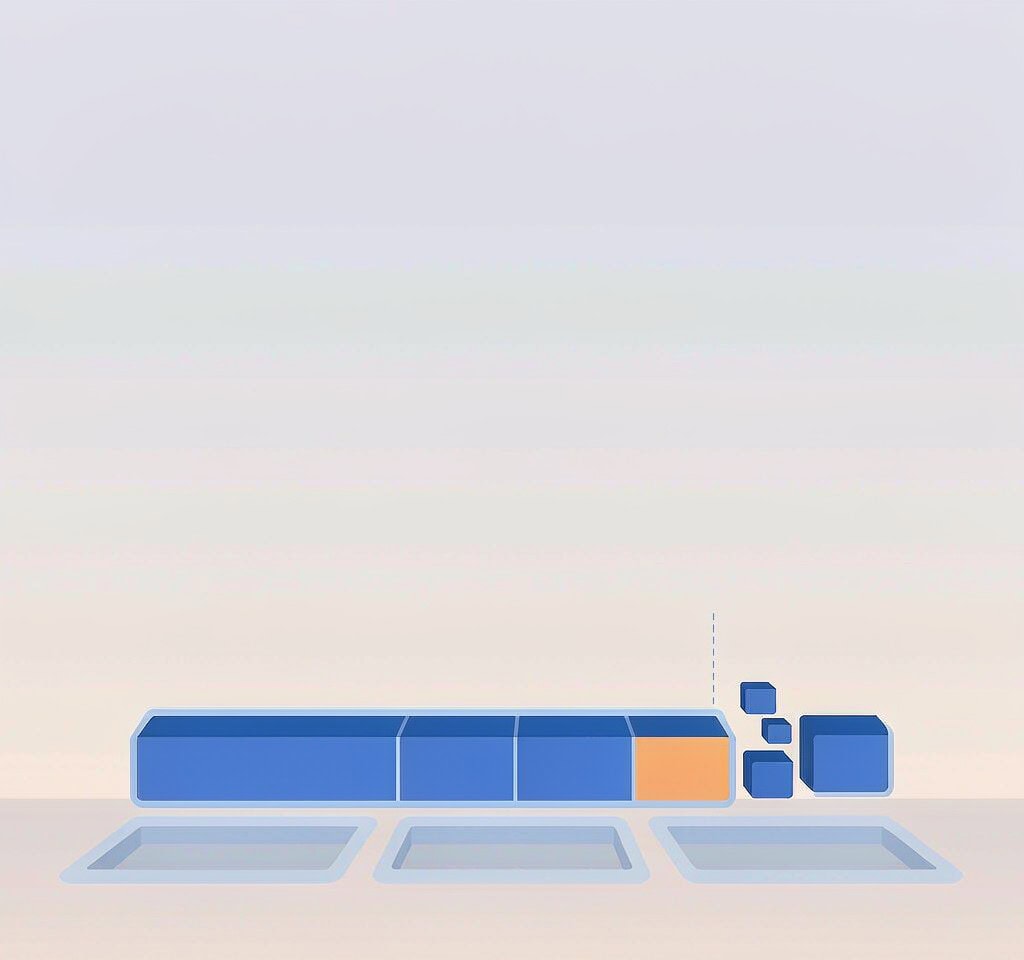
Chaptering is inherited from FAT32, which caps a single file at 4 GB. At the bitrates action cameras have used for a decade, that is somewhere between four minutes of 4K and half an hour of 1080p, so long recordings have always been chopped into fixed-size segments. Newer bodies format cards as exFAT and could write one enormous file, and most of them still chapter, because editors handle small files more gracefully, cloud features depend on uploads that can succeed or fail on their own, and a damaged chapter then costs you one chapter rather than an entire shoot.
The mechanism is described in more detail in the breakdown of how chaptered video files work. What matters for risk is that a chapter is not a fragment of a larger file. Each one is a complete, independently valid MP4 with its own index, header, and directory entry.
The handoff window, step by step
Between two chapters the camera runs a fixed sequence, and it is not encoding frames during any of it.
- Stop accepting frames for the outgoing chapter, which is already at its size limit.
- Flush the encoder buffer, writing out the last group of pictures.
- Write and commit the outgoing chapter’s index. This is the moov atom, and on most action cameras it sits at the end of the file, which makes it the last thing written.
- Update the file system. The directory entry gets a final size, the allocation table records the clusters, and the free-space structures are updated.
- Allocate clusters for the incoming chapter, create its directory entry, and write its header.
Steps three and four are metadata operations. They are small in bytes and expensive in time, because flash storage cannot rewrite a single byte: a small update means reading a block, erasing it, and programming it again. The window stretches on cards that are nearly full or whose free space has fragmented into small islands.
In practice the handoff occupies somewhere between roughly two hundred milliseconds and a couple of seconds. The exposure is real but not enormous, which is why a camera that power-cycles at the wrong moment fails so repeatably.
Why the last chapter is the one that dies

Every battery failure lands on the chapter that was open at the time, and the chapter that is open when a recording ends is always the last one. That alone explains why the final chapter appears damaged far more often than any other.
Three amplifiers make it worse. Battery failures cluster at the end of a recording, because the shoot got longer and the cell got emptier. Cold weather raises a cell’s internal resistance, so the camera may hit its cutoff voltage while the gauge still reads a third. And the final chapter needs its index written on a clean stop, so pressing stop and immediately removing the battery recreates the same failure without any power cut at all.
A parallel failure involves your data rather than the file structure. Action cameras write motion telemetry alongside the video, and that stream splits at chapter boundaries too. Gyro-based stabilization run afterward will find a gap in the motion track and either refuse the clip or produce a section that drifts.
How one interruption takes two chapters with it
| File involved | State after a power cut in the handoff window | Recoverable? |
|---|---|---|
| Previous chapter | Complete frames, no index written | Very often; the index can be rebuilt |
| Previous chapter | Index partly written | Usually; a rebuild discards the partial index |
| Next chapter | Directory entry exists, file is zero bytes | No data to repair; frames were never written |
| Next chapter | Header written, a few seconds of frames | Often; the fragment is small but real |
| Next chapter | No directory entry created at all | Carve-only; signature search finds the frames |
| Any earlier closed chapter | Fully committed | Yes, untouched |
The last row is the reassuring one. Chapters that closed before the interruption are complete objects with committed indexes, and nothing that happens later disturbs them, which is why a two-chapter loss on a twenty-chapter recording is survivable rather than catastrophic.
The failure mode people underestimate is the zero-byte file. It looks like a file that failed to recover and invites repeated rescanning, but the directory entry was created before the interruption and the payload never followed, so there is no data on the card to find. Look one chapter earlier, where the real loss is.
The same trap on every chaptered recorder
The mechanism is not a GoPro quirk. It appears anywhere a device writes sequentially numbered segments and closes each one before opening the next.
| Device class | Segmentation | Where the handoff hurts |
|---|---|---|
| Action cameras | Fixed-size chapters, typically around 4 GB | Every boundary; the last chapter most of all |
| Drones | Size- or time-based chapters | Compounded by a battery that cuts power on landing |
| 360 cameras | Two files per chapter, one per lens | Two files to damage per boundary |
| Dashcams | Short loop segments, oldest overwritten first | Overwriting begins while the current segment is open |
| AVCHD camcorders | Many clips sharing one playlist index | Damage to the shared index can orphan several clips |
That last row is the worst of the group and the least obvious. AVCHD camcorders do not give each clip a fully independent index; one clip information file describes a set of them, so damage there can leave a whole folder of recordings unreadable even though every clip’s video data is present.
Keeping the damage inside one chapter
You cannot eliminate the window, but you can shrink what it costs.
- Use shorter chapters where the camera allows it. A shorter value means less footage in the open file. Where no setting exists, stopping and restarting manually every ten to fifteen minutes achieves the same thing.
- Start long recordings on a full battery, and carry a spare. The way battery voltage behaves under load explains why a gauge reading 30 percent can cut out under sustained write current.
- Keep the card below about 80 percent full, because free space fragmented into small islands is what stretches the handoff window.
- Let the camera finish writing before you touch anything. Wait for the write light to go out and the screen to show the saved file. Many “corrupt chapter” reports are cards removed during the final index write.
Recovering a chapter set after an interruption
Stop recording on that card and do not format it. Copy the whole folder of chapters to a computer before running any tool, and if the card is behaving inconsistently, take a sector-level image and work from that. Recover the chapters as a set rather than one at a time so that numbering and timestamps stay coherent, and let the camera’s own repair feature have the first attempt if it offers one, since the camera knows its own container layout.
Then handle the unplayable chapter with the chapter repair procedure, which rebuilds a missing index using a healthy clip from the same camera as a structural reference. Once every chapter plays, join them back into a single continuous clip, which is a lossless concatenation rather than a re-encode.
Two details are worth planning around. The low-resolution proxy files frequently survive an interruption that kills the main chapter, because they are ten times smaller and flush to the card sooner, and the salvage route for .LRV and .THM files covers what such a proxy is worth. If the chapters are absent rather than damaged, start with the recovery guide for deleted action camera clips, and for interruptions that were not power cuts at all see the wider procedure.
If you are on Windows and the card is still detected by a computer, a purpose-built tool such as XRecovery (xappset.com) can scan SD, microSD, and other memory cards for deleted or formatted photos and videos, and it can re-encode recovered clips that will not open. Chaptered recordings illustrate the usual boundary well: a chapter that was never written cannot be recovered, a chapter whose index is missing can usually be repaired or re-encoded, and frames that have been overwritten are gone. Stop writing to the card and save the recovered files to a different drive.
Frequently Asked Questions
Why does only the last chapter fail when my battery dies?
Because the last chapter is the one the camera had open. Everything before it was closed and committed, index included. A power cut can only damage the file being written at that instant, plus the one the camera was about to open.
Can a corrupted chapter damage the chapters before it?
No. Each chapter is a complete, independently indexed MP4, and closed chapters are never written again. Damage at a boundary is confined to the outgoing and incoming files, so a two-chapter loss is the realistic worst case on a healthy card.
The chapter shows zero bytes. Is it recoverable?
No, and rescanning will not change that. A zero-byte file means the directory entry was created before the interruption but no frames were ever written. Look at the previous chapter instead, which is where the recoverable footage usually sits.
Why is my low-resolution proxy longer than the recovered MP4?
The proxy and the main file are written on separate schedules, and the proxy is small enough to flush much sooner. A longer proxy does not mean footage was lost from the main recording.