
Drone storage media is usually assumed to mean one thing: the microSD card in the gimbal bay. That assumption holds for most consumer aircraft and breaks completely on the models that ship with internal storage, where footage never touches a removable card at all. The distinction decides everything about recovery, because a card can be pulled and read on any computer, while soldered flash cannot.
One question separates the two cases before any tool is opened: can the card come out? If yes, the standard recovery path applies. If no, the work shifts to the aircraft, its file system, and in some models its encryption layer.
Every Storage Layer a Modern Drone Can Use

An aircraft can carry up to five distinct storage layers, and they are not interchangeable from a recovery standpoint.
| Layer | Typical implementation | Removable | Managed by | Recovery route |
|---|---|---|---|---|
| Removable card | microSD / microSDXC, UHS-I or UHS-II | Yes | Card’s own controller | Read directly in a card reader |
| Internal buffer | Soldered eMMC 5.x, 8-64 GB | No | Aircraft SoC | Export from the device, or chip-off |
| Internal system storage | Soldered UFS 2.x / 3.x | No | Aircraft SoC | Export, then laboratory work |
| Internal high-capacity store | Dedicated SSD-class module | No | Aircraft SoC | Export, then laboratory work |
| External recorder | USB-C SSD or dedicated recorder | Yes | Recorder’s own controller | Read from the recorder’s media |
The first and last rows behave like ordinary computer storage. The three middle rows do not, and they are the reason this page exists.
microSD and microSDXC: The Removable Layer
Almost every consumer drone records to a microSD card, and the bus it uses is the familiar one. UHS-I tops out at 104 MB/s, UHS-II raises that to roughly 312 MB/s, and the video speed class marking (V30, V60, V90) is the number that matters for recording rather than the read figure printed on the packaging. The differences between card families are covered in camera memory card types.
Two properties of this layer matter enormously after a failure. The card’s controller presents a standard block device, so a computer can read it without knowing anything about the aircraft. And SD-family cards implement no TRIM command, so when a file is deleted the card marks the blocks free and leaves the data physically in place. That single protocol detail is why a deleted drone clip on a microSD card is often recoverable while the same clip on internal storage may not be.
The removable layer has its own risks, of course. It can be dropped, lost with the aircraft, bent, or counterfeited. A card whose controller reports a capacity larger than its NAND can hold silently overwrites the oldest files once the real limit is passed, which is the failure described in counterfeit microSD cards in drones.
eMMC and UFS: Storage That Lives Behind the SoC
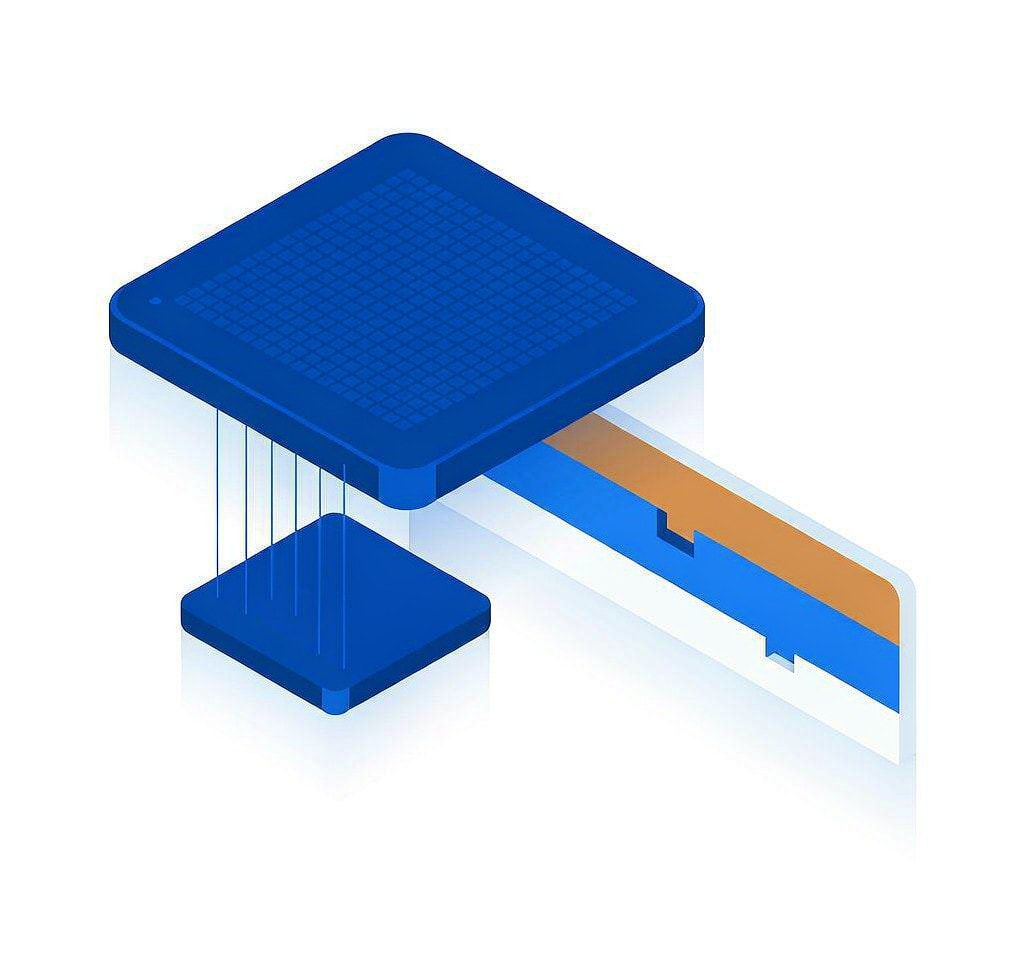
Internal storage in a drone is soldered flash, and it is not a simpler version of a memory card. It is a different category of device.
An eMMC package contains NAND dies and a controller, and it speaks the MMC interface to the aircraft’s processor. UFS is the newer standard, with a faster, full-duplex link that reaches into the low gigabytes per second range. In both cases the media is managed by the aircraft’s system-on-chip, which means three things follow.
The flight system owns the file system. Internal storage in an Android- or Linux-based flight stack is typically formatted with a journaling file system such as ext4 or F2FS rather than exFAT. Deleted files are recorded as free extents, and the journal may be overwritten quickly by normal system activity.
The device can issue discard commands. This is the crucial difference from a memory card, and the one most often missed. An operating system managing eMMC or UFS can tell the controller that a range of blocks is no longer needed. The controller is then free to erase them in the background at its leisure. On a card, that conversation cannot happen. On internal storage, deleted footage can be genuinely gone within minutes of the deletion, with no overwrite required in the usual sense.
The device must be working to access the data. A microSD card can be read on a bench years after the aircraft is destroyed. Internal storage cannot be read without the aircraft booting, or without desoldering the package and reading the NAND directly.
Some manufacturers add a fourth complication on top of these: encryption. Where internal footage is encrypted, a chip-off recovery yields ciphertext unless the key material is also recovered, which is a laboratory problem rather than a software one. That situation is set out in encrypted drone storage.
Why Internal Storage Feels Safer and Recovers Worse
Buyers treat internal storage as a bonus. No card to forget, no card to lose, footage always on board. That intuition inverts under a recovery lens.
A removable card is the most recoverable medium in the entire drone. It presents a simple block device, it has no TRIM, its file system is well documented, and it can be imaged without the aircraft being present. Internal storage is the least recoverable medium in the same aircraft: it needs a working host, it can discard deleted blocks on its own, and on some models it is encrypted.
The second inversion concerns what the internal layer is actually for. On several models it does not function as a backup copy of the card at all. It behaves as a fallback or a cache — the aircraft writes to the card when one is installed, and the internal store holds the most recent clips or whatever the card could not accept. Pilots who assume it is a second copy sometimes discover after a flight that the internal store held a rolling window rather than the whole session, and that the window has already cycled.
How the Layers Interact on a Normal Flight
Understanding the interaction explains most confusing reports about “missing” footage.
- Card present, internal storage empty or ignored. The default on most consumer aircraft. Everything of value is on the removable card.
- No card installed. The aircraft falls back to internal storage, often at reduced recording time and sometimes at a lower bitrate. This footage exists nowhere else.
- Card full or too slow. Some models continue recording to internal storage, or stop recording entirely and log a warning. The two outcomes look identical until you land and check.
- High-bitrate modes on professional airframes. The internal store may be the primary target because the card bus cannot sustain the data rate. In that configuration the removable card holds proxies or nothing at all, which is the opposite of the usual assumption.
- External recorder attached. The recorder’s SSD becomes the primary target and the aircraft’s own storage holds only what the link dropped.
Recording priority also explains a pattern that looks like data loss: when the aircraft switches targets mid-flight, the clip set is split across two devices with different file naming schemes, and pilots who inspect only one conclude a file is missing.
Reading a Drone’s Storage Configuration Off the Spec Sheet
Marketing pages rarely state the storage hierarchy plainly. These are the signals that identify it.
| Spec-sheet phrase | What it usually means | What to assume for recovery |
|---|---|---|
| “microSD, up to 512 GB” | Card only, no internal store | Easiest case; keep the card removable |
| “8 GB internal storage” | Small fallback buffer, typically rolling | Not a backup; treat as volatile |
| “64 GB / 1 TB built-in storage” | A real internal store, often SSD-class | Export early; do not rely on it surviving a fault |
| “UFS 3.1 internal memory” | Soldered system storage | Requires a working host or laboratory work |
| “Supports USB-C SSD recording” | External recorder is the primary target | Check the recorder’s media separately |
| “Encrypted internal storage” | Onboard encryption layer | Software cannot resolve this; laboratory case |
The single best habit for a buyer is to confirm that the highest-quality recording mode can be written to the removable card. If a mode is internal-only, then that mode’s footage inherits the worst recovery properties of the whole aircraft.
Getting Footage Out When It Never Touched a Card
Two paths exist, and the order matters.
While the aircraft still powers on. Use the manufacturer’s export function over USB or Wi-Fi and copy the internal files to a computer before doing anything else. Do not run a firmware update, do not reformat the internal store to “clean it up”, and do not keep flying with internal storage full. The extraction procedure is covered in extracting footage from drone internal storage, and the model-specific case is in DJI internal storage recovery.
When the aircraft no longer powers on. There is no software answer. Recovery means removing the storage package and reading the NAND directly, and where encryption is present it also means recovering the key material. This is laboratory work, in the same category as recovery from professional and soldered media.
If you are on Windows and the card from the aircraft is still detected by a computer, a purpose-built recovery tool such as XRecovery (xappset.com) can scan microSD, SD, and other memory cards for deleted or formatted video files. As with any recovery tool, stop writing to the card first and always save recovered files to a different drive. Software reads a medium; it cannot reach storage that is soldered behind a broken host.
For the removable-card case, buy from authorized sellers and check capacity with a real write test rather than trusting the label, as described in verified microSD cards for drones. The wider recovery picture across drones and action cameras, including which devices put footage where, is collected in drone and action camera data recovery.
Frequently Asked Questions
Do drones have internal storage as well as a memory card?
Some do. Many consumer models have a small internal fallback store, and professional airframes may carry a large internal module or SSD. It is not usually a backup copy of the card; on many models it behaves as a cache or rolling buffer that holds only recent or unrecorded clips.
Why is a microSD card easier to recover than eMMC?
Because it can be read independently and cannot be told to discard data. A card presents a simple block device that any computer can read, and SD-family cards implement no TRIM command, so deleted data stays physically in place. Internal eMMC and UFS storage can be issued discard commands by the flight system, which may erase freed blocks in the background.
Can internal drone storage be recovered if the aircraft will not power on?
Not with software. If the host cannot boot, the storage package has to be removed and the NAND read directly, which is laboratory work. Where the internal storage is encrypted, the key material also has to be recovered, because a chip-off read alone returns ciphertext.
Does a bigger internal drive make drone footage safer?
No, and it can make the situation worse in one respect. Internal storage is not removable, can discard deleted blocks on its own, and is sometimes encrypted, so it is the least recoverable medium in the aircraft. A large internal drive is convenient, not a substitute for a removable card copy.