SD card recovery is an attempt to interpret information that still exists. It may recover a file’s contents, its original organization, both, or neither. Understanding those different outcomes helps explain why a scan can show thousands of candidates while only some satisfy the user’s actual recovery goal.
This explanation concerns ordinary readable SD storage and general recovery methods. It is not a benchmark of XRecovery or any other product, and it does not infer camera-specific reconstruction capabilities from a supported file extension.
The file and the information describing it are different
A stored photograph has image bytes, but a file system also needs information that helps locate and describe those bytes. Names, lengths, directory relationships, allocation state, and data locations play different roles. Damage to one part does not imply the same damage to every other part.
In exFAT, for example, directory entry sets describe files, an allocation bitmap tracks allocation, and a FAT chain is not required for every contiguous allocation. Microsoft’s exFAT specification documents these structures. Describing all SD recovery as “restoring the FAT table” therefore hides important differences between file systems and allocation patterns.
For a reader deciding what to do next, the implication is practical: losing the normal directory view does not by itself prove that file contents were erased. Conversely, recovering a plausible name and size does not prove the referenced contents are complete.
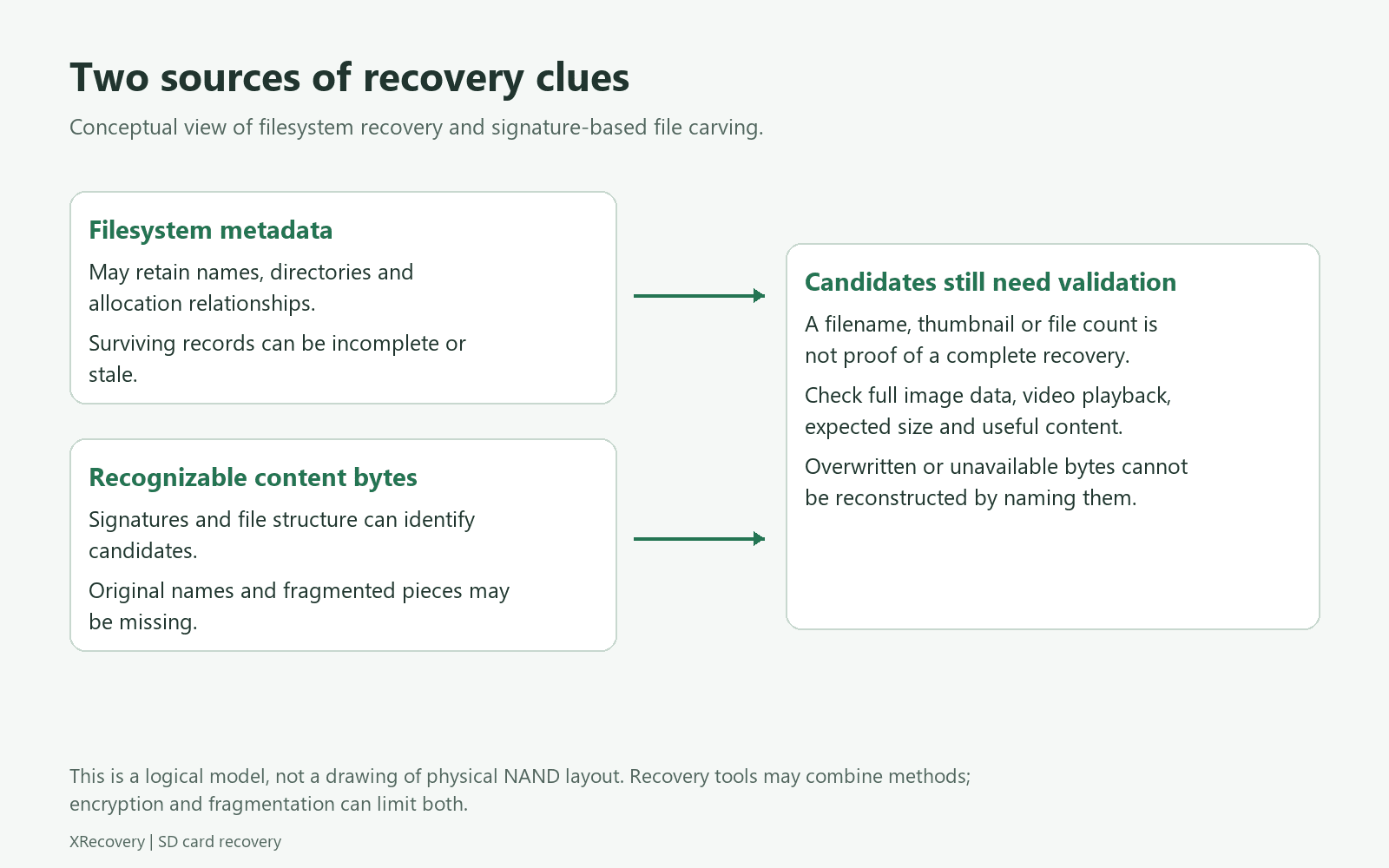
File-system-aware recovery uses surviving relationships
A recovery tool can analyze remaining structures to identify candidate files and their data locations. Where enough information survives, this can preserve useful names and folder organization. Where records are incomplete, reused, or inconsistent, that association becomes less reliable.
Consider an illustrative example, not a measured recovery case. A directory entry may describe a photograph from an earlier shoot, while some data areas formerly associated with it now contain newer material. A familiar filename can appear in the results even though the exported image is incomplete or unrelated in part. Opening the recovered file is necessary to distinguish these outcomes.
A file-system-aware scan should therefore be assessed by the content it retrieves and the evidence behind its reconstruction. A neatly reconstructed folder tree is helpful, but it is not the final success criterion.
File carving searches for recognizable content
File carving looks for patterns associated with file formats rather than depending entirely on the original directory. CGSecurity describes PhotoRec as a file carver and notes that this approach does not normally preserve original filenames. See its recovery-method overview.
This approach can be useful when directory information is unavailable, but it has limits. A candidate start must still be associated with the right continuation and ending. Embedded content, old data, missing regions, and fragmented allocation complicate the interpretation.
That is why signature results may include generated names, multiple candidates for similar content, or pieces that are not complete standalone files. The presence of a JPEG-like beginning or an MP4-related structure should be treated as evidence to examine, not as proof of a full original.
Fragmentation makes reconstruction a different problem
A file is fragmented when its data occupies separate logical areas rather than one uninterrupted run. If the original location relationships are lost, a carver may not know which separated regions belong together. Some methods can reconstruct particular fragmented formats under particular conditions; that is a capability to verify, not assume.
Video illustrates the distinction well. A container can describe several tracks and timing relationships in addition to picture data. A tool might identify part of a clip without retrieving everything needed for complete playback. The video guide therefore validates duration, seeking, audio, and the end of a recording rather than only the first frame.
Do not use a claim such as “deep scan supports MP4” as evidence that every fragmented camera recording is recoverable. Useful product evidence would identify the camera, recording mode, software build, test conditions, and what was actually restored.
Formatting changes the starting evidence
The word format is insufficient to predict recovery. An operation can recreate file-system structures, overwrite user data, or invoke device-specific behavior. Even if some older contents remain, the metadata that linked them into files may have changed.
The formatted-card guide explains how to record the exact operation and subsequent use. Do not convert a statement about one utility’s quick format into a promise about every camera’s format command.
Overwriting is a separate limitation from losing a filename. If the bytes necessary for an original file have been replaced, searching more thoroughly does not restore those previous bytes. A partially surviving file may still have value, but it must be described as partial rather than silently counted as complete.
Imaging preserves a readable state; it does not prove completeness
An image is a copy of data read from the source, together with whatever acquisition records the workflow preserves. Its value is that later analysis can work on the saved data instead of repeatedly accessing the original card.
The image’s existence alone does not establish that every area was read correctly. A useful acquisition record identifies errors, skipped areas, interruptions, and the device involved. A file sized like the nominal card capacity can still contain unresolved regions.
Keep an unchanged master and use separate working copies for experiments. A checksum can help detect whether a saved copy later changed; it cannot establish that an unread sector was recovered or that a camera file inside the image is valid. This distinction prevents an integrity check on the container from being mistaken for a recovery-success check on the contents.
Read-only analysis and hardware risk are separate
A tool that does not intentionally write to the source can reduce one kind of risk. It does not make a failing card immune to further problems during reading. Connection instability, overheating, and unreadable regions still require judgment about whether to continue.
Similarly, a mechanical card-lock tab is not a complete description of a forensic preservation workflow. The host’s handling and the actual interface matter. See the write-protection guide before treating a lock setting as a universal guarantee.
A read-only scan reduces the risk of source writes; it does not guarantee healthy hardware or complete files. Assess those questions separately when deciding whether to continue and when validating the result.
Encryption changes what readable bytes mean
A card can be physically readable while its contents require encryption keys. Android adoptable storage, for example, is associated with its original device. Access to encrypted sectors is not the same as access to usable photos. Preserve the relevant device and key context rather than attempting to solve an encryption problem by reformatting or changing extensions.
This is also why a card’s brand and capacity are insufficient to select a recovery method. The original device configuration and loss history matter alongside the media itself.
Judge recovery at the level the user needs
| Evidence | What it supports | What it does not establish |
|---|---|---|
| Device appears with plausible capacity | Some storage-level communication | Health of every area |
| Original filename appears | A possible metadata relationship | Complete original content |
| Thumbnail looks correct | A recognizable preview | Full-resolution image integrity |
| Clip plays at the start | Some decodable media | Complete duration and audio |
| Export copy has a stable checksum | Consistency of that saved copy | Equality to an unavailable original |
| Needed files open and pass task-specific checks | A useful verified result | Recovery of every missing file |
Define success as a specific set of validated files. Record incomplete and unknown outcomes separately. That approach produces a more meaningful recovery report than a percentage based on everything a scan happened to list.
For an actual case, return to SD Card Recovery and choose the guide matching the observed symptom. Technical understanding should help select a controlled next step, not encourage experiments on the only remaining copy.