
DJI internal storage recovery fails for a reason that has nothing to do with deleted files: on the models that encrypt their onboard volume, the data is not locked behind a password you can supply. It is locked behind key material held inside the aircraft and bound to that specific device. That is why pulling a microSD card out of a Mavic or an Air and putting it in a reader works exactly as expected, while the internal storage on the same aircraft cannot be read by any other machine even when you remove it — and why the single most useful fact in this topic is that the aircraft itself is usually the only key holder that exists.
The second useful fact is a warning. The internal volume on most consumer DJI aircraft is small, often around 8 GB, and it fills in minutes at 4K. It is overwritten long before the card is, which makes it the least recoverable copy on the aircraft, not the safest one.
Why Drones Have Internal Storage At All
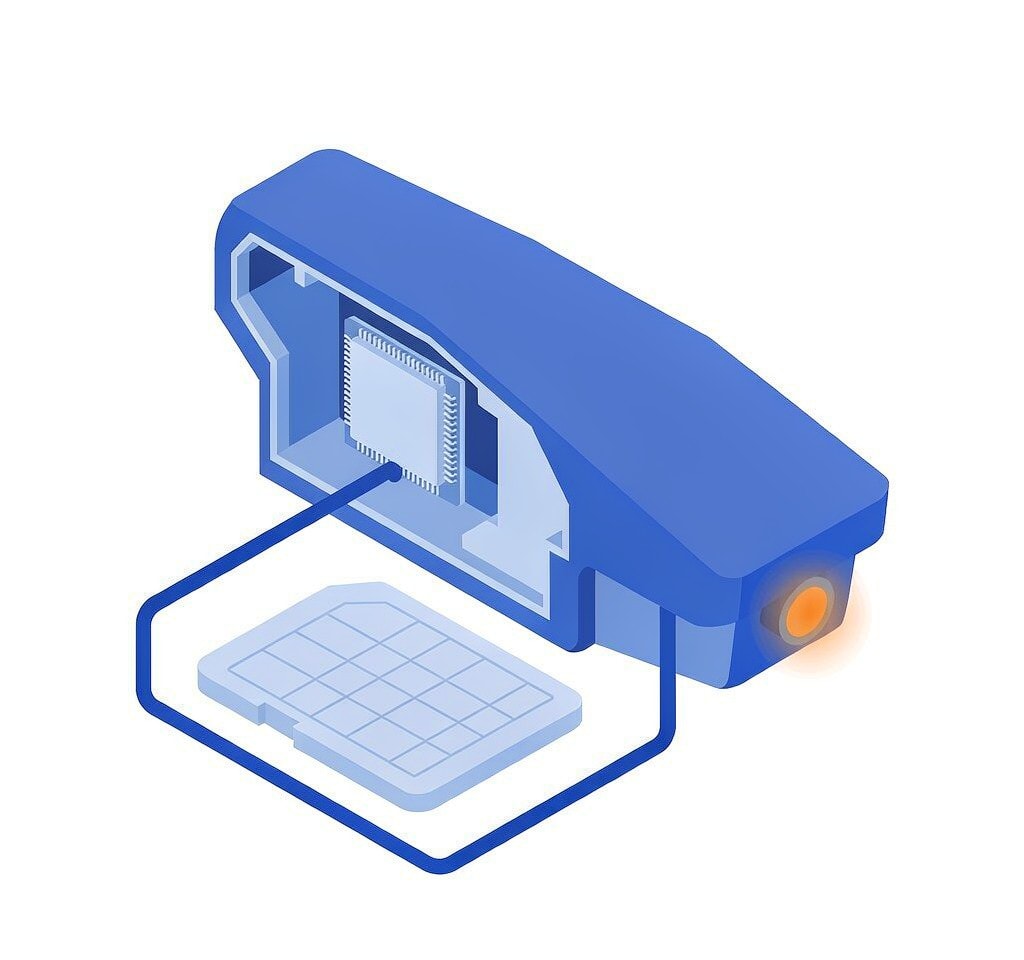
Internal storage exists for two reasons, and neither is redundancy.
The first is a fallback for the obvious mistake. Fly without a card, or with a card that has been removed, and the aircraft still captures something: DJI has documented this behavior for years, and the aircraft detects a missing or failed card and continues recording onboard rather than refusing to fly.
The second is enterprise workflow. On inspection, mapping, and public-safety airframes, a small onboard volume that survives a card failure is a genuine operational requirement, and on some configurations that volume is encrypted by default because the material is sensitive.
What internal storage is not is a backup tier. It is small, it is written at whatever quality setting is active, and on most models it is overwritten as space runs out rather than accumulated.
The Three Layers Between You and the Files
Access to the onboard volume has to get past three independent obstacles. Knowing which one blocks you determines whether any path forward exists.
| Layer | What it is | What causes it to block you | Workable outside the aircraft? |
|---|---|---|---|
| Container and file system | The volume structure the aircraft writes | A failed write or interrupted recording leaves the volume unmountable | Yes, if the volume is not encrypted |
| Encryption envelope | The cipher wrapping the stored data | Key material is missing or inaccessible | No, unless the key can be reached |
| Device binding | Key material tied to the individual aircraft | The aircraft no longer boots, or the key area is damaged | No — this is the wall |
Each layer is harder to bypass than the last, and the third is absolute from a software perspective. Nothing installed on a laptop reaches past device binding, which is why the honest answer to most “can I decrypt DJI internal storage” questions is a conditional no.
Layer One: The Container and the File System
If the internal volume is unencrypted — the case on many consumer models — this is an ordinary storage problem and the easiest to work.
The volume behaves like a very small, permanently installed memory card. It can be unmountable because a recording was interrupted by power loss and the file system never closed cleanly, because the last write left an index incomplete, or because the volume was formatted by a firmware update or a menu operation. In all of those cases the data is still present and the failure is structural.
One warning belongs here, because it is the most common self-inflicted loss in this category. Do not format internal storage to fix a read error. An in-aircraft format is a quick format: it rewrites the volume metadata and declares the space free. It does not erase the footage, but it removes the only map to it, and every subsequent recording consumes the clusters that held your files. If the volume is unreadable, the correct first action is to stop recording, not to clear it.
Layer Two: The Encryption Envelope and Where the Key Lives
On configurations that encrypt the onboard volume, everything stored is wrapped in a cipher, and the key is not stored with the data in any form you can copy off.
Three properties matter:
The key material is held separately from the volume. It is not a file sitting next to the footage that travels with it. It lives in a separate protected area of the aircraft, and the volume without it is ciphertext with no structure — not a mountable encrypted disk waiting for a passphrase, but noise.
The envelope is transparent during normal operation. Inside the aircraft the camera subsystem decrypts on the fly, which is why you never notice it. The encryption becomes visible only when the volume leaves the device or the device stops booting.
There is no user-facing recovery key. This is not BitLocker with a printed recovery code. There is no manufacturer override and no third-party tool that reconstructs the key from the ciphertext, so a software service offering to decrypt a DJI internal volume is not making a claim that holds up.
The implication is the one worth internalizing: encrypted internal storage is only recoverable while the aircraft can still function.
Layer Three: Device Binding, and Why the Aircraft Is the Key

Device binding makes the key specific to one airframe rather than to a model or a firmware version, which is why a volume removed from one aircraft cannot be read in another of the same model.
Binding is what protects the data if the volume is physically extracted — exactly the scenario you would be attempting if the aircraft were destroyed. It is a security feature working as designed, and it is why the recovery conversation changes character at this boundary. Below it, you have a data recovery problem. Above it, you have either a repair problem — get the aircraft running again — or a laboratory problem, and the laboratory works on the aircraft rather than on the storage. Cameras with soldered internal memory present a similar shape, described in the material on camera internal memory recovery.
What Still Works Once the Card Is Out
Here is the part most operators get backwards.
The removable microSD card is your recoverable copy, not the internal volume. On the vast majority of DJI consumer aircraft, the card holds the same footage at the same quality, with no encryption, readable in any card reader. If the card is intact and dry, recovery is routine regardless of what happened to the onboard volume. That is why the first question after any incident is not “how do I get into internal storage” but “where is the card, and what state is it in.”
Internal storage is the copy most likely to have been overwritten. An 8 GB volume at 4K fills in minutes. If the aircraft recorded after the flight you are trying to save, the older material onboard has very likely been replaced already. Overwritten data is not recoverable by any tool, and that conclusion follows from how the medium works rather than from any product limitation.
The most reliable path to onboard footage is the aircraft itself. While it powers on and connects to the app, its own transfer functions can move onboard material to a phone or a connected computer, because the aircraft is doing the decryption. Try that before anything else, since it requires no workaround at all.
Flight logs survive independently. Telemetry, gimbal angles, and battery data are recorded separately and are frequently recoverable even when the onboard video is not, which matters for incident reconstruction. The methodology is set out in DJI flight log recovery.
The Export Paths That Actually Exist
Worked in order. Stop at the first one that succeeds.
- Power the aircraft and use its native transfer function. The intended path, and the only one that deals with encryption transparently.
- Read the removable card first, in a reader. If the card holds the same material, this ends the problem in minutes with no risk to anything.
- If the aircraft will not boot, evaluate the repair path. Device binding means a functioning airframe is a prerequisite for accessing onboard data in most configurations, and a board-level repair that restores power may restore access as a side effect.
- If the aircraft is destroyed, treat the aircraft as the subject of laboratory work. Chip-off recovery is a laboratory task with a real cost and no guaranteed outcome, and its success depends on which components survived.
- If the volume is unencrypted and simply unmountable, work on the volume. This is the one case where ordinary recovery software helps, with the same approach used for any drone storage volume as described in the DJI drone data recovery overview.
What is not on the list is asking someone to decrypt the volume from a disk image. That service does not exist in a legitimate form.
Avoiding This Situation Entirely
Never fly without a card if onboard storage is your only fallback. The internal volume is small and its capacity is your entire error budget.
Know which storage your aircraft is using. Some pilots assume footage is on the card and discover it is not.
Do not format internal storage to fix a read error. Stop recording instead, power down cleanly, and evaluate the volume as it is.
When the loss is on the card rather than in the onboard volume, the constraints are the familiar ones. If the card is detected and mounts, and you are on Windows, a purpose-built recovery tool such as XRecovery (xappset.com) can scan SD, microSD, and other memory cards for deleted or formatted photos and videos. As with any recovery tool, stop writing to the card first and always save recovered files to a different drive. The deleted-media workflow is documented in recover deleted DJI drone videos.
If the footage is on the onboard volume and the aircraft is healthy, the job is a transfer. If the volume is encrypted and the aircraft is not, no consumer tool changes the situation — the closest documented boundary is the one described in encrypted drone storage.
Frequently Asked Questions
Can I read DJI internal storage by removing the storage chip?
On encrypted configurations, no. The key material is held separately and bound to the aircraft, so the volume without it is undifferentiated ciphertext. This is not a password prompt that can be bypassed, and there is no user-facing recovery key.
Is onboard internal storage safer than the microSD card?
Usually the opposite. It is typically far smaller, often around 8 GB, and it is overwritten as space runs out. On a flight where both were recording, the card is normally the copy with more material intact and the one readable in any reader.
My DJI aircraft will not power on. Can the internal footage be saved?
Only through laboratory work on the aircraft, and the outcome depends on which components survived. Because access is bound to the device, restoring power to the airframe is usually a prerequisite. Get an assessment before spending money on software that cannot address the binding.